L2B: Learning to Balance the Safety-Efficiency Trade-off in Interactive Crowd-aware Robot Navigation
IROS2020
TL;DR A robot that learns when to ask a crowd to make room and when to detour, raising navigation success in dense crowds.
Overview
This work presents a deep reinforcement learning framework for interactive navigation in a crowded place. Our proposed approach, Learning to Balance (L2B) framework enables mobile robot agents to steer safely towards their destinations by avoiding collisions with a crowd, while actively clearing a path by asking nearby pedestrians to make room, if necessary, to keep their travel efficient. We observe that the safety and efficiency requirements in crowd-aware navigation have a trade-off in the presence of social dilemmas between the agent and the crowd. On the one hand, intervening in pedestrian paths too much to achieve instant efficiency will result in collapsing a natural crowd flow and may eventually put everyone, including the self, at risk of collisions. On the other hand, keeping in silence to avoid every single collision will lead to the agent's inefficient travel. With this observation, our L2B framework augments the reward function used in learning an interactive navigation policy to penalize frequent active path clearing and passive collision avoidance, which substantially improves the balance of the safety-efficiency trade-off. We evaluate our L2B framework in a challenging crowd simulation and demonstrate its superiority, in terms of both navigation success and collision rate, over a state-of-the-art navigation approach.
Video
Collision Avoidance or Path Clearing?
When a robot moves through a dense crowd, it has two options: wait for people to pass and avoid them (passive collision avoidance), or ask nearby people to make room (active path clearing, e.g., by beeping). Neither is good on its own.
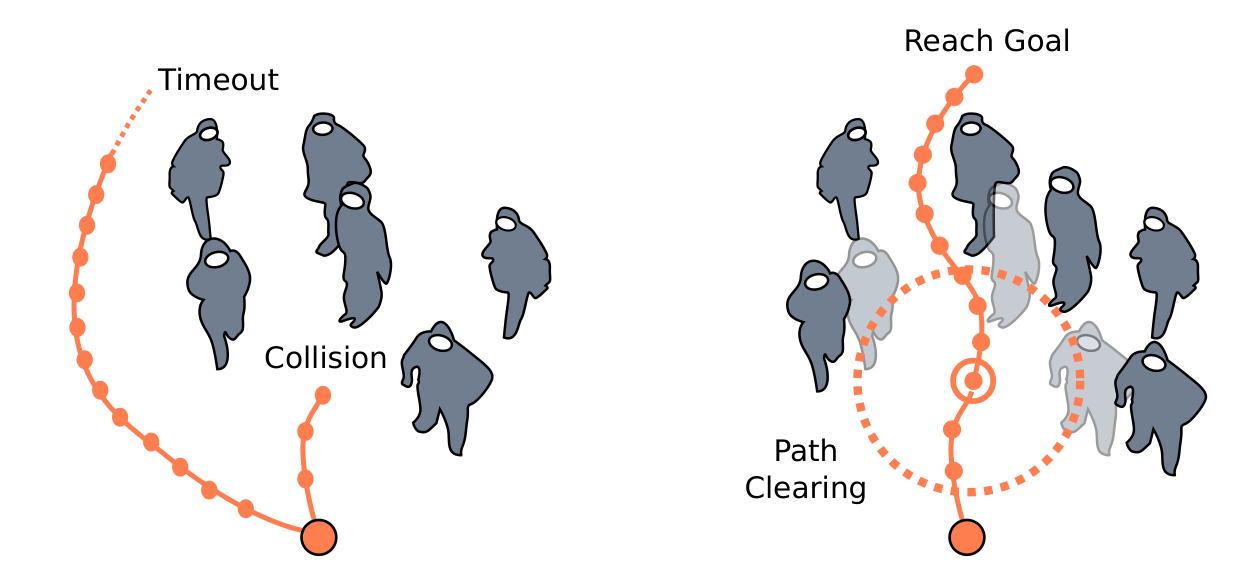
- Only avoiding keeps everyone safe, but in a crowded scene the robot cannot find a gap. It freezes, takes long detours, and eventually times out or collides (Fig. 1, left).
- Always intervening gets the robot through quickly at first, but pushing people around collapses the natural crowd flow. Once the crowd has no room left to give way, everyone, including the robot, is at higher risk of collision.
We view this as a social dilemma between the robot and the crowd, treated as a single virtual crowd agent. Mutual cooperation is when both sides make reasonable room for each other. Passive avoidance alone leaves the robot with the sucker outcome , and aggressive path clearing gives the robot a short-term temptation payoff that turns into mutual defection once the crowd can no longer make room. L2B learns when to clear a path and when to detour, so the robot stays in (Fig. 1, right).
Method
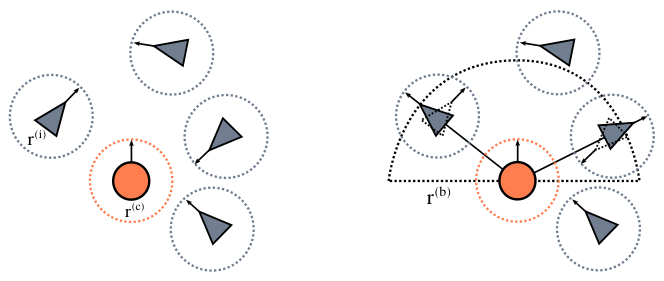
L2B augments the navigation reward with a term coming from the crowd. Its first part, weighted by , penalizes active path clearing when pedestrians are within the beep range , discouraging the move from to . Its second part, weighted by , penalizes getting closer than a discomfort distance, discouraging the move from to . Setting makes getting too close worse than clearing a path, so the policy learns to stay in by using both actions sparingly. The value network is trained with V-learning on top of SARL.
To simulate how a crowd reacts to path clearing, pedestrians follow a simplified Emotional Reciprocal Velocity Obstacles (ERVO) model: everyone inside the half-circle of radius in front of the robot changes direction when it beeps. The simulator is available at Python-ERVO.
Results
In circle-crossing scenarios with N pedestrians, L2B-SARL keeps its success rate around 90% as the crowd grows, while the SARL baseline drops to 70.0% at N = 20, mainly because of timeouts.
Success, collision and timeout rates, and average navigation time
| N | Methods | Success [%] ↑ | Collision [%] ↓ | Timeout [%] ↓ | Time [s] ↓ |
|---|---|---|---|---|---|
| 20 | SARL | 70.0 | 18.4 | 11.6 | 13.50 |
| L2B-SARL (ours) | 90.6 (+20.6) | 9.4 (-9.0) | 0.0 (-11.6) | 13.85 (+0.35) | |
| 15 | SARL | 77.8 | 6.4 | 15.8 | 12.43 |
| L2B-SARL (ours) | 88.0 (+10.2) | 11.8 (+5.4) | 0.2 (-15.6) | 11.60 (-0.83) | |
| 10 | SARL | 92.2 | 4.6 | 3.2 | 11.91 |
| L2B-SARL (ours) | 90.4 (-1.8) | 8.6 (+4.0) | 0.4 (-2.8) | 11.31 (-0.60) | |
| 5 | SARL | 96.6 | 3.2 | 0.2 | 10.09 |
| L2B-SARL (ours) | 97.8 (+1.2) | 2.0 (-1.2) | 0.2 (±0) | 10.14 (+0.05) | |
| avg. | SARL | 84.1 | 8.1 | 7.7 | 11.98 |
| L2B-SARL (ours) | 91.7 (+7.6) | 7.9 (-0.2) | 0.2 (-7.5) | 11.72 (-0.26) |
Qualitative results
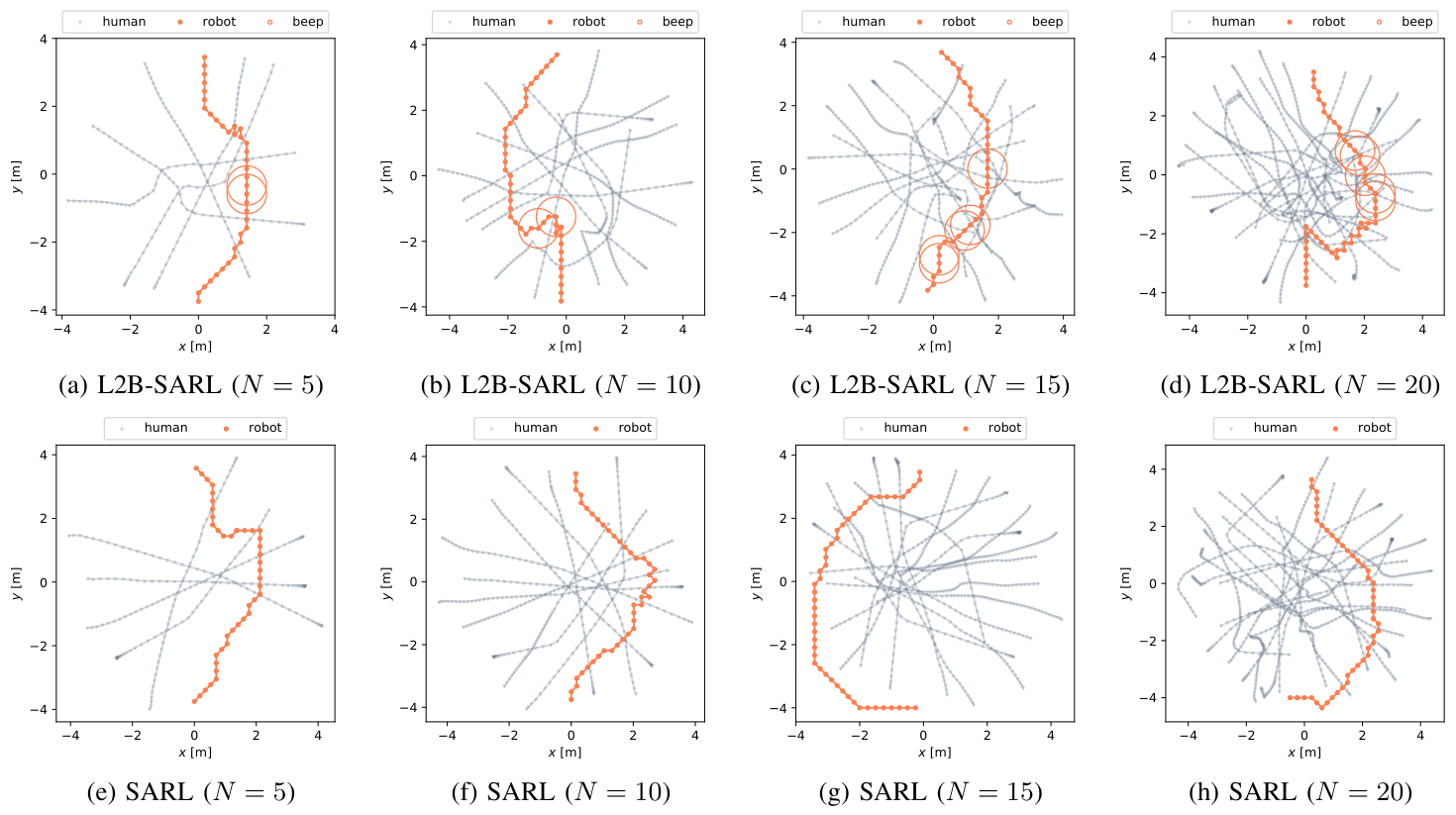
L2B-SARL (top) clears its path with a few beeps and goes through the crowd, while SARL (bottom) takes long detours around it.
Balancing path clearing
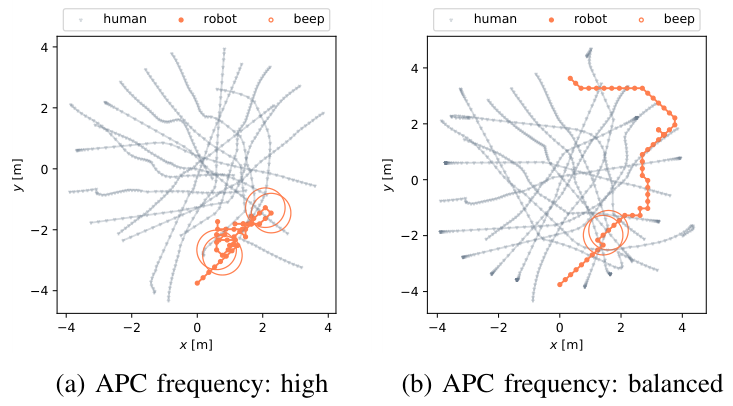
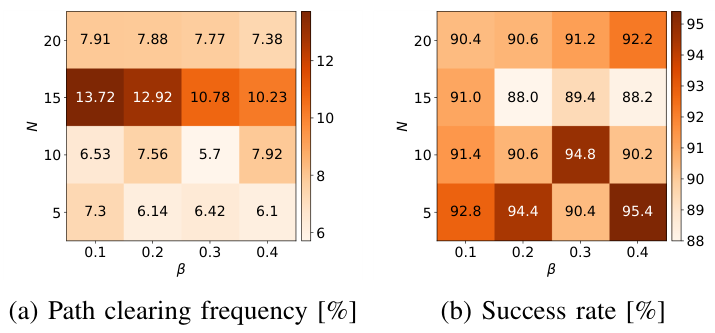
With too small a penalty , the robot beeps too often, confusing the crowd and causing collisions. L2B learns to mix path clearing and collision avoidance.
Contact
Citation
@inproceedings{nishimura2020l2b,
  title={L2B: Learning to Balance the Safety-Efficiency Trade-off in Interactive Crowd-aware Robot Navigation},
  author={Nishimura, Mai and Yonetani, Ryo},
  booktitle={2020 IEEE/RSJ International Conference on Intelligent Robots and Systems (IROS)},
  address={Las Vegas, NV, USA},
  organization={IEEE},
  year={2020}
}