PHASE: Compliance-Enabled Tactile Phase Retrieval for Few-Shot Insertion Learning
IROS2026'%3e%3cmetadata%20id='metadata16'%3e%3crdf:RDF%3e%3ccc:Work%20rdf:about=''%3e%3cdc:format%3eimage/svg+xml%3c/dc:format%3e%3cdc:type%20rdf:resource='http://purl.org/dc/dcmitype/StillImage'%20/%3e%3cdc:title%3e%3c/dc:title%3e%3c/cc:Work%3e%3c/rdf:RDF%3e%3c/metadata%3e%3cdefs%20id='defs14'%3e%3cclipPath%20clipPathUnits='userSpaceOnUse'%20id='clipPath28'%3e%3cpath%20d='M%200,1080%20H%201920%20V%200%20H%200%20Z'%20id='path26'%20/%3e%3c/clipPath%3e%3cclipPath%20clipPathUnits='userSpaceOnUse'%20id='clipPath128'%3e%3cpath%20d='M%200,1080%20H%201920%20V%200%20H%200%20Z'%20id='path126'%20/%3e%3c/clipPath%3e%3cclipPath%20clipPathUnits='userSpaceOnUse'%20id='clipPath18'%3e%3cpath%20d='M%200,1080%20H%201920%20V%200%20H%200%20Z'%20id='path16'%20/%3e%3c/clipPath%3e%3c/defs%3e%3csodipodi:namedview%20pagecolor='%23ffffff'%20bordercolor='%23666666'%20borderopacity='1'%20objecttolerance='10'%20gridtolerance='10'%20guidetolerance='10'%20inkscape:pageopacity='0'%20inkscape:pageshadow='2'%20inkscape:window-width='1440'%20inkscape:window-height='914'%20id='namedview12'%20showgrid='false'%20fit-margin-top='0'%20fit-margin-left='0'%20fit-margin-right='0'%20fit-margin-bottom='0'%20inkscape:zoom='0.434375'%20inkscape:cx='484.54599'%20inkscape:cy='90.825431'%20inkscape:window-x='-6'%20inkscape:window-y='-6'%20inkscape:window-maximized='1'%20inkscape:current-layer='g18'%20/%3e%3cg%20id='g18'%20inkscape:groupmode='layer'%20inkscape:label='SINICX_Logo_2024_06%20(1)'%20transform='matrix(1.3333333,0,0,-1.3333333,-871.99998,786.66665)'%3e%3cg%20id='g122'%3e%3cg%20id='g124'%20clip-path='url(%23clipPath128)'%3e%3cg%20id='g130'%20transform='translate(1236,540)'%3e%3cpath%20d='m%200,0%20c%200,14.984%209.494,26.752%2030,27.5%20l%20-2,20%20C%20-3,45.572%20-22,25%20-22,0%20c%200,-25%2019,-45.572%2050,-47.5%20l%202,20%20C%209.494,-26.752%200,-14.984%200,0%20m%20-74,47.5%20-2,-20%20c%2020.506,-0.748%2030,-12.516%2030,-27.5%200,-14.984%20-9.494,-26.752%20-30,-27.5%20l%202,-20%20c%2031,1.928%2050,22.5%2050,47.5%200,25%20-19,45.572%20-50,47.5%20M%20-158,-50%20c%2010.163,0%2023.222,1.516%2035.5,7.5%20l%201,21.5%20c%20-15.419,-7.98%20-24.349,-9.5%20-34,-9.5%20-22.885,0%20-35,10.715%20-35,30.5%200,20.281%2011.498,31%2033.5,31%2010.539,0%2019.19,-2.25%2033.5,-10%20l%20-1,21%20c%20-12.951,6.497%20-23.605,8%20-33.5,8%20-34.125,0%20-55.5,-19.341%20-55.5,-50%200,-30.784%2021.128,-50%2055.5,-50%20m%20-103.5,2.5%20h%2022%20v%2095%20h%20-22%20z%20M%20-536,-50%20c%2027.127,0%2042,11.809%2042,30.326%200,23.018%20-24.358,28.393%20-43.5,31.7%20-13.347,2.306%20-23,4.28%20-23,10.8%200,5.697%206.895,8.092%2021.673,8.092%2013.023,0%2027.965,-2.697%2040.327,-7.592%20l%20-1,21%20C%20-515.737,49.045%20-526.907,50%20-539,50%20c%20-26.578,0%20-43,-10.415%20-43,-27.122%200,-22.856%2023.488,-27.807%2042.038,-31.027%2013.246,-2.343%2024.462,-4.36%2024.462,-12.006%200,-8.118%20-10.957,-10.019%20-20.5,-10.019%20-15.487,0%20-27.243,4.543%20-45.5,13.674%20l%201,-22.5%20c%2015.24,-7.948%2031.788,-11%2044.5,-11%20m%2077.5,2.5%20h%2022%20v%2095%20h%20-22%20z%20m%2060.5,95%20h%2021%20l%2055,-63.5%20v%2063.5%20h%2022%20v%20-95%20h%20-21%20L%20-376,16%20v%20-63.5%20h%20-22%20z'%20style='fill:%23000000;fill-opacity:1;fill-rule:nonzero;stroke:none'%20id='path132'%20/%3e%3c/g%3e%3c/g%3e%3c/g%3e%3c/g%3e%3c/svg%3e)
TL;DR A compliant wrist reveals insertion phases from touch, so phase-consistent retrieval lifts few-shot peg-in-hole success by 13 points.
Overview
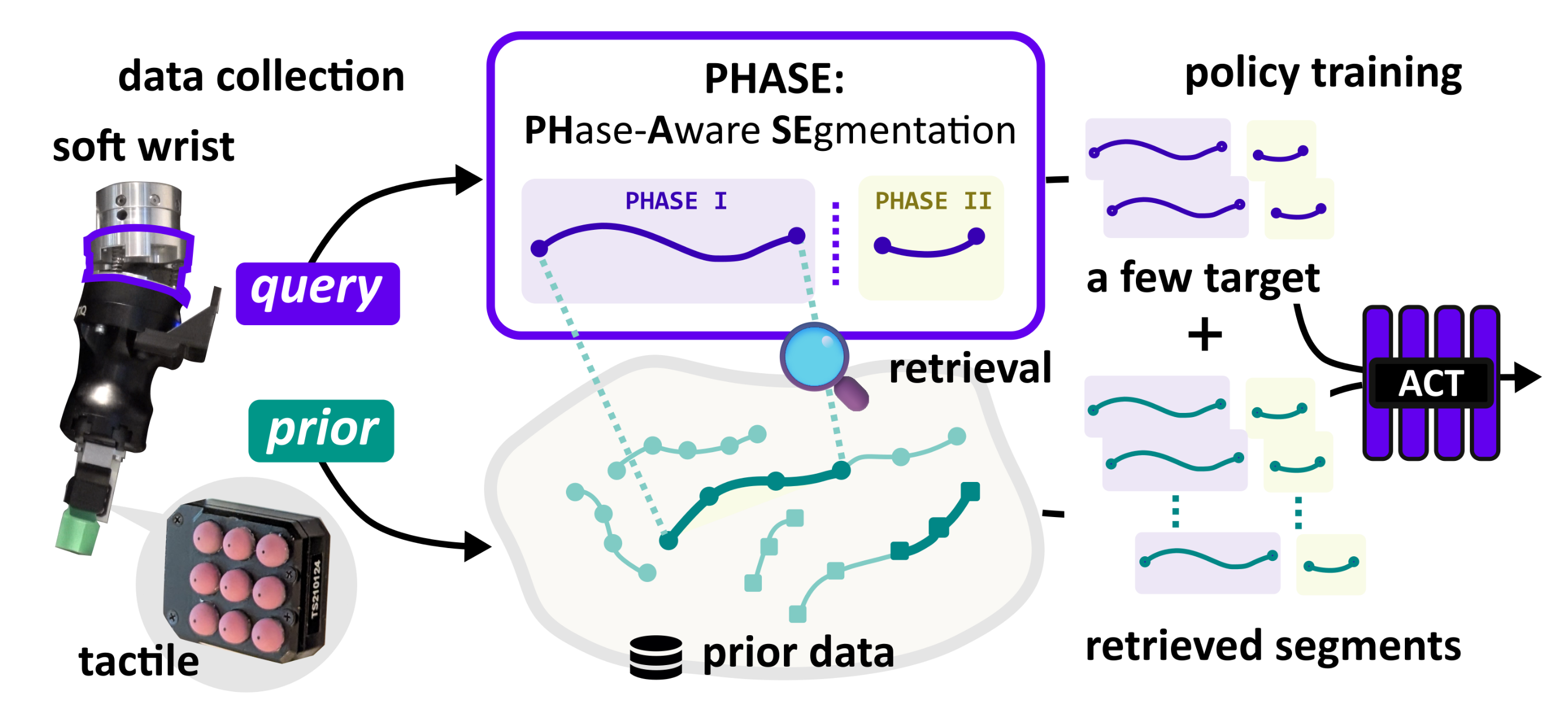
Contact-rich assembly tasks such as peg-in-hole insertion remain difficult to learn from limited demonstrations. While retrieval-augmented imitation learning, which augments target demonstrations with relevant prior data, offers a promising direction, its applicability to contact-rich manipulation remains largely unexplored. Contact-rich insertion unfolds over multiple phases from search to insert, and retrieving phase-specific experience from prior data in principled ways remains an open question. Our key insight is that a compliant wrist enables the robot to sustain contact throughout execution, producing rich tactile and force signals that naturally reveal the phase structure of insertion and inform what should be retrieved. Based on this insight, we present PHASE (PHase-Aware Segmentation and REtrieval), a framework for compliance-enabled tactile phase retrieval that integrates multimodal contact-aware representation learning, variable-length phase segmentation from tactile signals, and phase- consistent retrieval for policy learning. We evaluate PHASE on real-world peg-in-hole insertion across five peg geometries, comparing against retrieval strategies drawn from state-of-the-art methods under a shared policy architecture. PHASE improves the overall success rate by 13 percentage points over the strongest non-phase-aware baseline, and improves performance under unseen initial positions by 30 percentage points. These results demonstrate that aligning retrieval with interaction-defined contact phases substantially improves robustness in few-shot insertion learning.
Video
Method
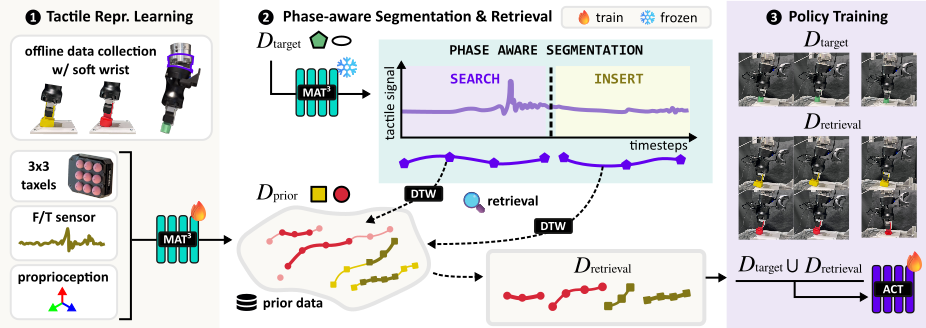
PHASE (PHase-Aware Segmentation and REtrieval) runs in three stages. A masked tactile-proprioceptive encoder named MAT is first trained on the prior dataset with self-supervised masked reconstruction, giving per-frame embeddings that capture force-driven interaction dynamics without any phase labels. Demonstrations are then segmented at interaction-defined boundaries and matched phase-to-phase, and an ACT policy is finally trained on the target demonstrations plus the retrieved, phase-consistent segments.
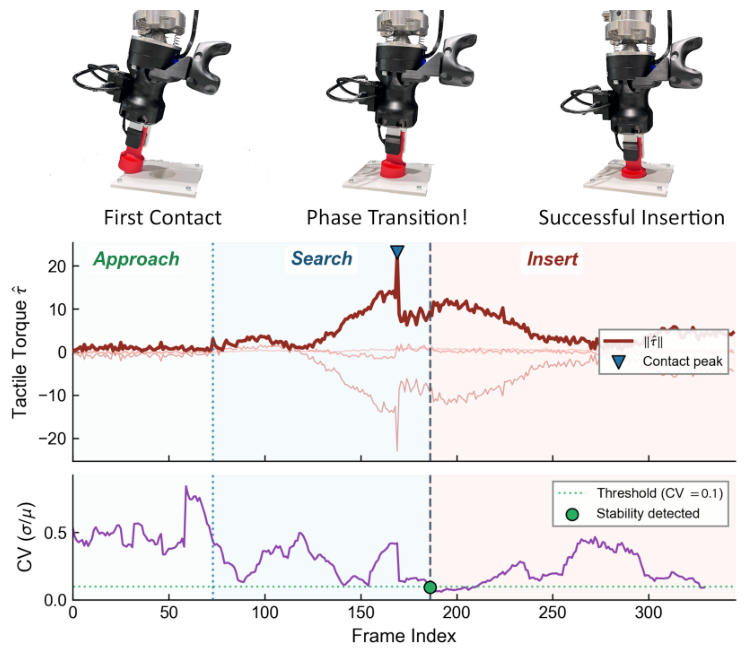
The soft wrist is what makes segmentation possible: passive 6D compliance keeps the peg in sustained contact, so the tactile-estimated torque stays smooth enough to read. A boundary is placed at the first frame after the contact peak where the coefficient of variation of drops below , the onset of stable engagement, splitting each insertion into a search and an insert phase. Because that moment depends on geometry and initial pose, the resulting segments are naturally variable in length, and retrieval uses FastDTW between per-frame embeddings so segments of different duration can still be aligned, restricted to matching phases.
Results
We evaluate on real-world peg-in-hole insertion with a UR5e, a soft wrist, and a 3×3 distributed tactile sensor, across five peg geometries: circle and square are in the prior data, while rectangle, oval, and hexagon are unseen. From 122 prior demonstrations and only 4 target demonstrations per shape, PHASE reaches 77% success, 13 percentage points above the strongest non-phase-aware baseline, and every retrieval strategy is compared under the same ACT policy architecture.
Real-world success rate (20 trials per shape, 100 per method)
| Seen Shapes | Unseen Shapes | |||||
|---|---|---|---|---|---|---|
| Method | Circle | Square | Rectangle | Oval | Hexagon | Total |
| Target-Only | 13/20 | 6/20 | 9/20 | 15/20 | 7/20 | 50/100 (50%) |
| BC-Prior | 19/20 | 10/20 | 4/20 | 17/20 | 14/20 | 64/100 (64%) |
| Retrieval-Single [8] | 13/20 | 7/20 | 7/20 | 14/20 | 15/20 | 56/100 (56%) |
| Retrieval-Full [38] | 16/20 | 9/20 | 7/20 | 19/20 | 13/20 | 64/100 (64%) |
| Retrieval-Window [4] | 16/20 | 10/20 | 6/20 | 16/20 | 7/20 | 55/100 (55%) |
| PHASE (Ours) | 18/20 | 12/20 | 13/20 | 20/20 | 14/20 | 77/100 (77%) |
The gap widens under distribution shift. Starting the robot from positions never seen in training, PHASE retains 47% success where the best baseline manages 17%.
Success rate under unseen starting positions (20 trials per shape, 100 total)
| Method | Circle | Square | Rectangle | Oval | Hexagon | Total |
|---|---|---|---|---|---|---|
| Target-Only | 0/20 | 0/20 | 0/20 | 0/20 | 0/20 | 0/100 (0%) |
| BC-Prior | 5/20 | 2/20 | 3/20 | 5/20 | 2/20 | 17/100 (17%) |
| Retrieval-Single [8] | 0/20 | 1/20 | 1/20 | 0/20 | 0/20 | 2/100 (2%) |
| Retrieval-Full [38] | 4/20 | 4/20 | 4/20 | 2/20 | 0/20 | 14/100 (14%) |
| Retrieval-Window [4] | 6/20 | 5/20 | 5/20 | 0/20 | 0/20 | 16/100 (16%) |
| PHASE (Ours) | 12/20 | 8/20 | 12/20 | 9/20 | 6/20 | 47/100 (47%) |
Contact
Citation
@inproceedings{siburian2026phase,
  title={PHASE: Compliance-Enabled Tactile Phase Retrieval for Few-Shot Insertion Learning},
  author={Siburian, Jeremy and Beltran-Hernandez, Cristian C. and Matsushima, Tatsuya and Iwasawa, Yusuke and Hamaya, Masashi and Nishimura, Mai},
  booktitle={2026 IEEE/RSJ International Conference on Intelligent Robots and Systems (IROS)},
  address={Pittsburgh, PA, USA},
  organization={IEEE},
  year={2026}
}